ABOUT THE ASSET
THE MAHMUT PASHA COMPLEX
560 YEARS OF HISTORY AND CONTINUITY
HISTORICAL BACKGROUND
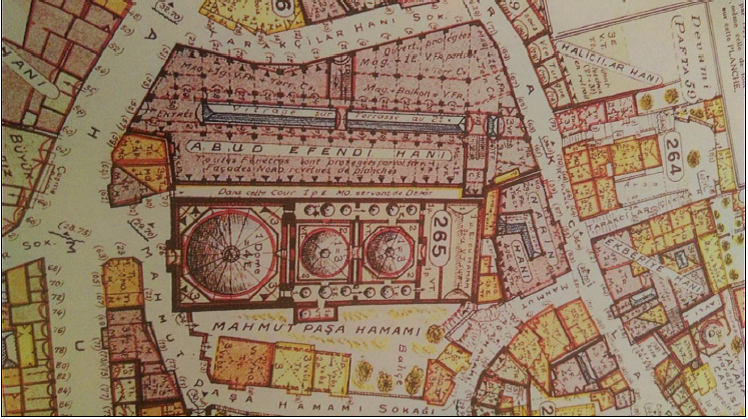
Mahmut Pasha Complex is located in the Fatih district, to the northeast of the Nuruosmaniye Complex. It stands on a block surrounded by Mahmutpaşa Mahkemesi Street, Mengene Street, and Şeref Efendi Street.
As the first grand vizier complex built after the conquest of Istanbul, the Mahmut Pasha Complex is one of the most important architectural groups of the 15th century, following the Fatih Complex. Since it is located in a densely built commercial area, the complex has been surrounded by later constructions over the centuries and has lost many of its original components. Today, the complex consists of the mosque, the tomb, the bath that lies outside the original unity of the complex, and the Kürkçü Han, which has largely disappeared among other commercial buildings.
At the time of its construction, the complex functioned as a large social center with one of the richest endowments after those of the sultan. The construction of the entire complex took approximately ten years, beginning in 1463 and completed in 1473. Originally, the complex included a mosque, a madrasa, an imaret (public soup kitchen), a bath, a primary school, the tomb of Mahmut Pasha, and a large inn. In addition, a courthouse building, whose architectural character is not well known today, was also part of the complex.
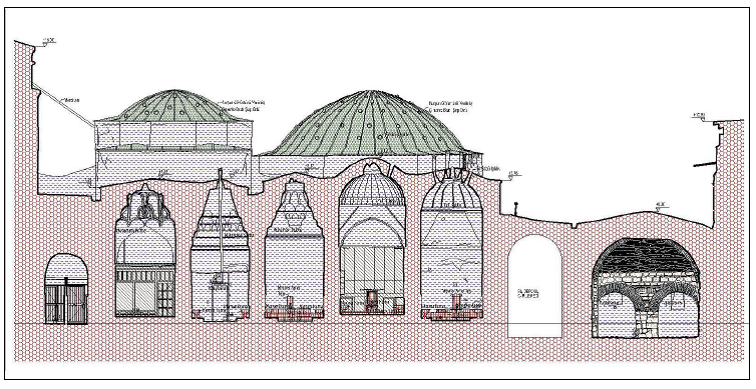
Due to several major fires in the commercial district, some buildings of the complex were completely destroyed without leaving any traces. After the great market fire of 1753, the madrasa was severely damaged, and today only its classroom section survives. A primary school was later built on the remaining part of the madrasa site. The imaret and the primary school belonging to the complex have not survived to the present day. However, the caravanserai known today as Kürkçü Han, built together with the complex, is the only surviving inn from the 15th century.
The Mahmut Pasha Complex, with its surviving mosque, inn, bath, and tomb, reflects the continuation of pre-conquest Ottoman architectural traditions in Istanbul. Except for the tomb, the other structures have largely lost their original decorative features and architectural details of their period.
Mosque: The Mahmut Pasha Mosque follows the plan type known as the tabhaneli or zaviye mosque, which is commonly seen in early Ottoman architecture. However, it differs from earlier examples of this type in certain aspects of its layout.
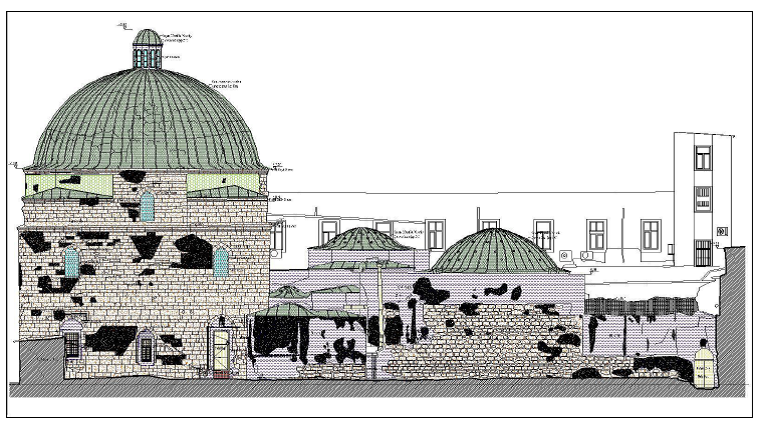
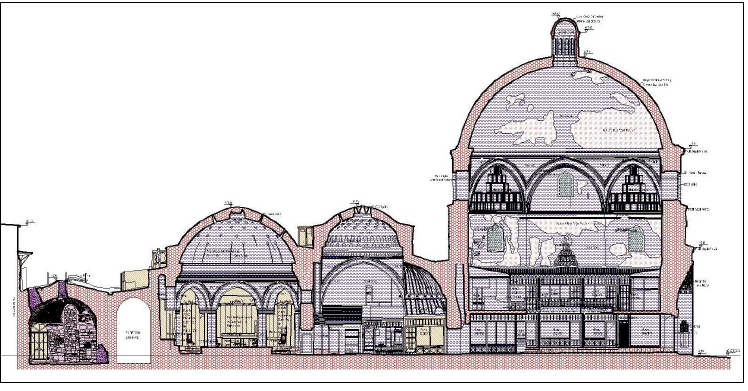
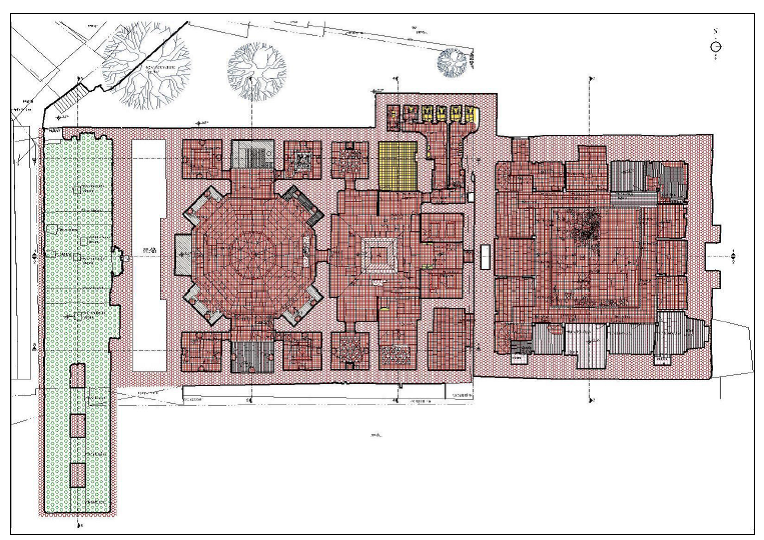
During the survey phase, the current condition of the building was documented in detail. In the restitution phase, visual, written, and oral sources were examined to understand the original design of the structure, and three different restitution proposals were developed for different historical periods. In the restoration phase, the aim is to return the Mahmutpaşa Bath to its original function as a bath, with minimal intervention to the building. All conservation works will be carried out using original materials as much as possible and with the least possible physical intervention.